



Sharp Divergence Among DeFi Altcoins: Critical Developments in the $74 Billion Market
DeFi-focused altcoin projects continue to experience different developments across the market.


The total value locked in decentralized finance (DeFi) continues to decline, while significant changes are taking place across protocols associated with leading altcoins such as Aave (AAVE), Lido DAO (LDO), Morpho (MORPHO), Uniswap (UNI), and Hyperliquid (HYPE). According to DefiLlama data as of November 14, 2026, the total value locked (TVL) in the DeFi ecosystem fell to $74.01 billion, representing a 3.24% decline over the past 24 hours. A 12.58% decrease in weekly trading volume on decentralized exchanges reflects slowing market activity, although certain protocols have managed to stand out through their trading volumes and revenue generation. Developments in lending, liquid staking, and decentralized derivatives markets provide particularly important indicators for evaluating the performance of DeFi altcoins.
Aave and Morpho Take Different Paths in Lending Markets
The latest TVL rankings of DeFi protocols show that most major projects have experienced weekly declines. Lido maintains its leading position with approximately $18.57 billion in total value locked, followed by Aave at $15.32 billion and Morpho at $10.50 billion. Lido's particularly sharp weekly decline of 14.72% highlights the pressure on the dollar-denominated value of assets locked in Ethereum-based staking protocols.
Leading DeFi Altcoins as of November 14, 2026
Altcoin | TVL | 7-Day TVL Change | Token Price |
|---|---|---|---|
Lido (LDO) | $18.57 billion | -14.72% | $0.29 |
Aave (AAVE) | $15.32 billion | -9.59% | $107.01 |
Morpho (MORPHO) | $10.50 billion | -4.37% | $1.92 |
Ethena (ENA) | $5.19 billion | -2.86% | $0.13 |
Uniswap (UNI) | $3.23 billion | -9.57% | $5.51 |
Hyperliquid (HYPE) | $1.73 billion | -6.10% | $69.06 |
For Aave, declining TVL is not the only development attracting attention. New decision-making processes related to risk management have also emerged. A proposal published by LlamaRisk on November 10 raised the possibility of freezing certain collateral assets on Aave V3 Core. As of November 9, the assets covered by the proposal represented approximately $1.33 billion in collateral and $1.03 billion in associated debt. Meanwhile, an Aave V4 assessment dated November 13 proposed increasing the USDC supply cap on Ethereum from $75 million to $85 million and raising the borrowing cap from $50 million to $60 million. These proposals should not yet be interpreted as implemented changes.
Morpho, meanwhile, is pursuing a different growth opportunity through applications that integrate real-world assets into DeFi lending. According to the protocol's November 6 announcement, Coinbase users can borrow USDC by using PAXG, a gold-backed token issued by Paxos, as collateral. According to figures shared by the company, the existing integration between Coinbase and Morpho supports approximately $3.4 billion in collateral and more than $1.7 billion in active loans. Morpho's relatively limited weekly TVL decline compared with Aave and Lido is also worth monitoring. However, no available data establishes a direct causal relationship between this performance and the new integration.
Uniswap Trading Volume Declines as Rival Exchanges Accelerate
A more pronounced divergence is emerging in the decentralized exchange (DEX) market. DefiLlama's DEX volume data shows that Uniswap processed approximately $2.18 billion in trading volume over the past 24 hours and $12.98 billion over the past seven days. Uniswap's weekly trading volume declined by 9.94% compared with the previous seven-day period, while PancakeSwap recorded a 3.93% increase to $5.75 billion. Weekly trading volume on Aero rose 7.99% to $5.95 billion. Meteora also registered approximately $952 million in weekly trading volume, representing a 12.04% increase.
Despite the decline in trading volume, product development efforts continue across the Uniswap ecosystem. A report published by Uniswap Labs on November 10 focused on new market models that could enable tokenized securities to trade through permissioned liquidity pools. According to the company, more than $20 billion in tokenized stock trading volume has been processed through the Uniswap protocol to date. The Aggregator Hooks technology, introduced in October, also enables liquidity from different sources to be accessed through Uniswap v4. These developments have the potential to create new use cases for UNI, although their eventual impact on the token's price remains uncertain.
Hyperliquid Maintains Derivatives Lead as Market Risks Increase
Hyperliquid continues to hold a strong position in DeFi's derivatives market. According to data from decentralized perpetual futures platforms, Hyperliquid's 24-hour derivatives trading volume stands at approximately $12.94 billion, while open interest totals $6.18 billion. The platform recorded $61.58 billion in trading volume over the past seven days, representing a 2.61% decline during the period. Among its competitors, Lighter reported approximately $3.36 billion in daily trading volume, while Aster recorded around $1.71 billion. Hyperliquid generated approximately $3.29 million in protocol revenue over the past 24 hours.
Other major market indicators also point to weakening risk appetite. The total stablecoin market capitalization declined to approximately $284.82 billion, reflecting a seven-day decrease of 1.53%. Meanwhile, actively managed assets associated with real-world assets reached approximately $30.43 billion, indicating that tokenization continues to play an important role within the DeFi ecosystem. However, it would be inaccurate to interpret the entire decline in TVL as capital outflows. Falling prices of ETH and other cryptocurrencies used as collateral can also reduce the dollar-denominated value of assets locked in protocols.
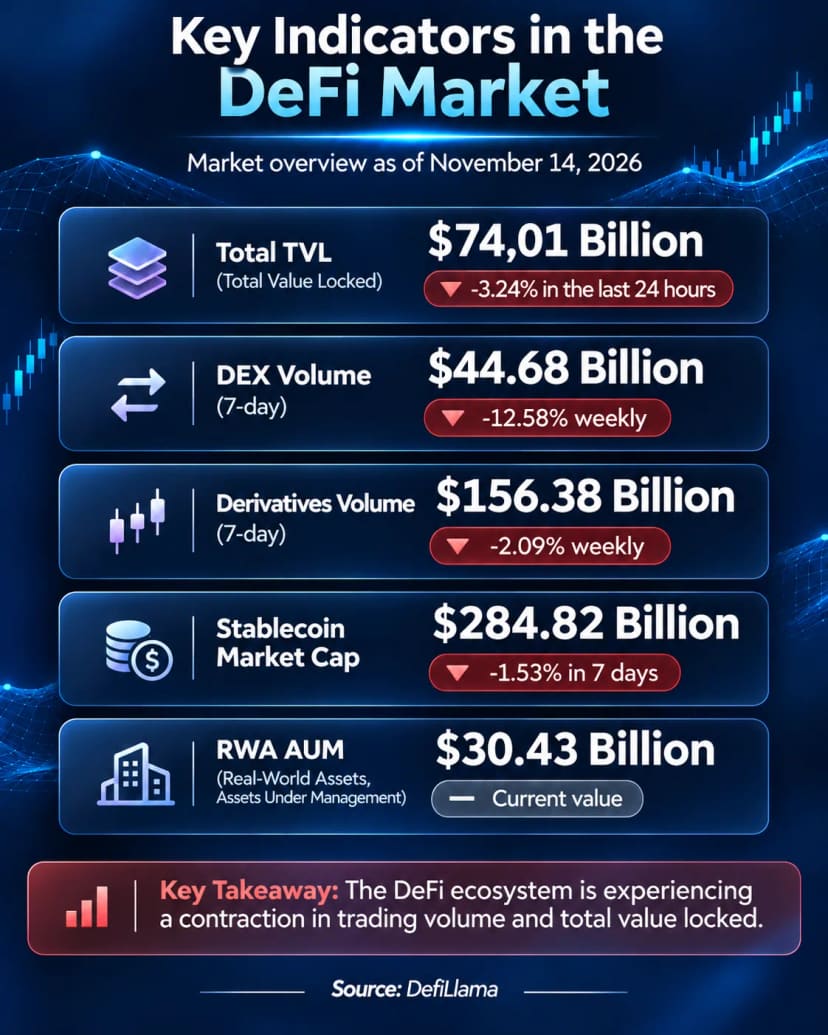
Source: DefiLlama, November 14, 2026 Market Overview.
Looking ahead, three indicators will be particularly important for AAVE, MORPHO, UNI, LDO, ENA, and HYPE: whether total value locked across their respective protocols recovers, whether trading activity translates into actual revenue generation, and whether new integrations succeed in increasing user demand. Current data points to a broader contraction across the DeFi market while demonstrating that certain projects can still differentiate themselves through product development and trading activity. However, protocol growth and altcoin price performance are not the same. Token supply, revenue-sharing mechanisms, and broader market conditions must be evaluated separately.
Spotted an error? Let us know · Our editorial standards
Disclaimer: This content is for informational purposes only and is not investment advice. Cryptocurrencies are high-risk; make investment decisions based on your own research.
Content Editor and Writer
Dr. Mesut İnan is a researcher, academic and crypto journalist who has been producing content about cryptocurrencies since 2018. He brings a different perspective to the industry by combining his expertise in sociology with the cryptocurrency ecosystem. Before joining Kriptofoni as co-founder, content editor and writer, İnan worked for several cryptocurrency media platforms: he was an editor and writer at Kriptokoin from 2018 to 2023 and at COINTURK from 2023 to 2024. İnan made a valuable contribution to the ecosystem with his book on Bitcoin, "Bitcoin Sen Bizim Her Şeyimizsin" (Bitcoin, You Are Our Everything). Alongside his academic background, his regular analyses, news and commentary have made him one of the well-known names in cryptocurrency journalism in Turkey. İnan continues his work as a writer and educator and remains a prominent expert voice in the cryptocurrency field.
All articles